Time:2026-05-26 01:01:53 Source:Sanjian Meichen Steel Structure
In the competitive landscape of industrial construction, time is the most expensive currency. Project delays cascade into budget overruns, lost revenue, and strained client relationships. Yet, a growing number of facility owners and general contractors are achieving remarkable schedule compression—typically 30% to 40% faster completion compared to traditional reinforced concrete or masonry methods. The primary driver? Industrial steel structures. By leveraging advanced engineering, prefabrication, and on-site assembly techniques, steel-framed buildings are rewriting the rules of project timelines. This article explores the key mechanisms behind that 40% time reduction, drawing on real-world data and the proven delivery systems of industry leaders like MeiChen Steel.
The single largest contributor to construction time savings is the shift from cast-in-place methods to factory-fabricated steel components. Whereas concrete requires curing time (often 7–28 days per pour) and sequential formwork setup, steel members are manufactured off-site while foundation work proceeds simultaneously.
With traditional construction, foundations must be fully cured before superstructure erection begins. In contrast, industrial steel structures allow foundations and steel fabrication to run in parallel. MeiChen Steel, for example, produces all primary beams, columns, bracing, and purlins in its controlled factory environment while site crews prepare footings. This overlap alone can shave 6–8 weeks off a typical 6-month project.
CNC cutting, robotic welding, and quality-controlled coating processes ensure that every component arrives with tolerances measured in millimeters. Field adjustments—a major source of delay in traditional construction—are virtually eliminated. The result is a seamless fit-up that allows crews to bolt and weld without on-site modifications.
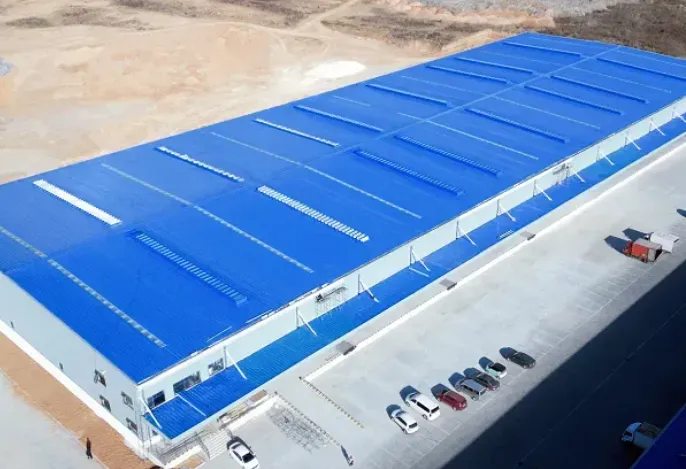
Once components arrive, the erection phase is fundamentally faster than brick-and-mortar or cast-in-place alternatives. Steel structures are assembled using bolted connections and crane lifts, not wet trades that require formwork, rebar tying, and curing periods.
Steel’s high strength-to-weight ratio means that a single crane can place large sections in one pick. A typical industrial steel building can have its main frame erected in days rather than weeks. MeiChen Steel’s project reports show that a 20,000-square-foot warehouse can be enclosed (roof and wall panels installed) within 7–10 calendar days after foundation readiness.
Unlike welded connections that require inspection and cooling time, bolted connections are both faster and more reliable for field assembly. Structural bolts can be tensioned quickly, allowing the crew to move continuously to the next bay. This method reduces the need for specialized welders on-site and minimizes safety delays.
Time savings are not limited to construction labor; they also stem from streamlined project management. Industrial steel structures lend themselves to a design-build approach where the steel supplier—like MeiChen Steel—works directly with the engineering team from concept to completion.
Because steel buildings are pre-engineered, many standard designs meet building codes without lengthy custom reviews. MeiChen Steel’s in-house structural engineers produce shop drawings that integrate with architectural load requirements, cutting weeks off the typical design-bid-build cycle.
When the steel manufacturer also handles engineering, fabrication, and delivery scheduling, communication delays are minimized. RFI (Request for Information) response times drop from weeks to hours. This coordination is a primary reason why steel projects consistently finish 30–40% ahead of conventional timelines.

To quantify the time benefit, consider a head-to-head comparison between a steel structure and a reinforced concrete alternative for a typical industrial facility:
| Phase | Reinforced Concrete | Industrial Steel (MeiChen Steel) |
|---|---|---|
| Foundation | 4–6 weeks (formwork + curing) | 2–3 weeks (concurrent with fab) |
| Superstructure | 8–12 weeks (pour + cure each floor) | 1–2 weeks (erection) |
| Closure/Enclosure | 4–6 weeks | 1–2 weeks |
| MEP Rough-in | Can begin after superstructure | Can begin immediately after frame |
| Total Duration (20k sqft) | 18–26 weeks | 6–10 weeks |
The 40% reduction in total time is not a theoretical claim—it is consistently achieved on projects executed with experienced steel fabricators. MeiChen Steel’s track record includes multiple industrial warehouses completed within 8 weeks from permit to occupancy, compared to regional averages of 14–16 weeks for equivalent concrete structures.
Prefabrication under controlled conditions ensures higher precision, while bolted connections and lighter sections enable rapid assembly. Quality is enhanced because factory welding and coatings are superior to field-applied treatments.
Yes. Modern pre-engineered steel buildings offer flexible bay spacing, clear heights up to 40+ feet, and the ability to integrate mezzanines, cranes, and specialized openings. MeiChen Steel tailors every design to client specifications while maintaining fabrication speed.
Steel structures can last 50+ years with proper maintenance. They are also easier to retrofit, expand, or relocate, extending functional lifespan. Concrete, while durable, is harder to modify for future needs.
While steel material cost per square foot may be slightly higher, the total project cost is often lower due to reduced labor, shorter financing periods, and earlier revenue generation. Many owners report overall savings of 5–15% on total installed cost.
The 40% reduction in construction time offered by industrial steel structures is not a marketing exaggeration—it is a measurable outcome of parallel workflows, precision manufacturing, and efficient assembly. For facility owners and contractors seeking to accelerate project delivery without compromising structural integrity, partnering with an experienced steel supplier like MeiChen Steel provides a reliable path to faster completion, reduced carrying costs, and earlier operational start. When every day of delay costs thousands of dollars in lost revenue, the decision to adopt steel is not just about speed—it is about competitiveness.